
Content
- Answers to your Questions
- When Do I Have Breakfast, Lunch and Dinner?
- How Much Do I Eat for Breakfast / Lunch / Dinner?
- Which Fruits Should You Eat for Breakfast, Which for Lunch and Why?
- Which Vegetables to Use for Making Green Juice?
- Should You Eat Fruit for Dinner on a Raw Diet?
- Why Smoothies Are NOT Optimal Food?
- How Long Have I Been on a Raw Diet?
- For the Very End
- Author
Answers to your Questions
In this video and blog post, you will get answers to some of the most common questions you have asked me about the free Raw Vegan Meal Plan online course.
This video and blog post from this page are the 10th lesson in the entire Raw Vegan Meal Plan online course. I strongly recommend that you join this course and do all the lessons. When you are inside the course you get
- video lessons
- written lessons with pictures
- quizzes to see how much you have you learnt from each lesson
- access to our private group in which you get a lot of support, information and answers to your questions
Participation in this online course is completely free. Join now HERE.
I got a lot of questions from you about this course. First of all, I want to thank all of you who participated in this course. It is my pleasure and honour to guide you on your journey of a raw vegan diet and health. Welcome!
Before I start with the answers, I want to mention something very important. You usually ask me what I do in my private life. Please keep in mind that the point is not that you copy me completely, but rather to take the essence of my teaching and adapt it to your preferences, circumstances, tastes, locality, season, and life activities.
And now let’s go to the most frequently asked questions and answers!

In the picture: Marina from Health Glows holding a plate full of fruit
When Do I Have Breakfast, Lunch and Dinner?
My meal schedule goes like this:
- Breakfast – 4 hours after getting up – in the first 4 hours I go to the gym, or exercise at home, run errands, do groceries, reply to emails
- Lunch – 3-4 hours after breakfast
- Dinner – 4 hours after lunch
Example: I get up at 8, have breakfast at 11, have lunch at 3pm and have dinner at 7pm.

In the picture: Marina from Health Glows standing in the kitchen behind a counter full of raw vegan food
How Much Do I Eat for Breakfast / Lunch / Dinner?
Each of my meals consists of somewhere between 600 and 700 kCal. Thus, my total caloric intake during the day is about 2,000 kCal.
Please note the following:
- Caloric needs are very individual and depend on many factors such as: gender, age, level of physical activity, muscle and fat ratio in the body.
- How many calories a person consumes is only one side of the whole equation! On the other side of the equation is how many calories a person spends in a day. In other words, it is important to know how many calories someone consumes in a day, and how many calories this same person spends in a day in order to have a complete picture of someon’s calorie intake.
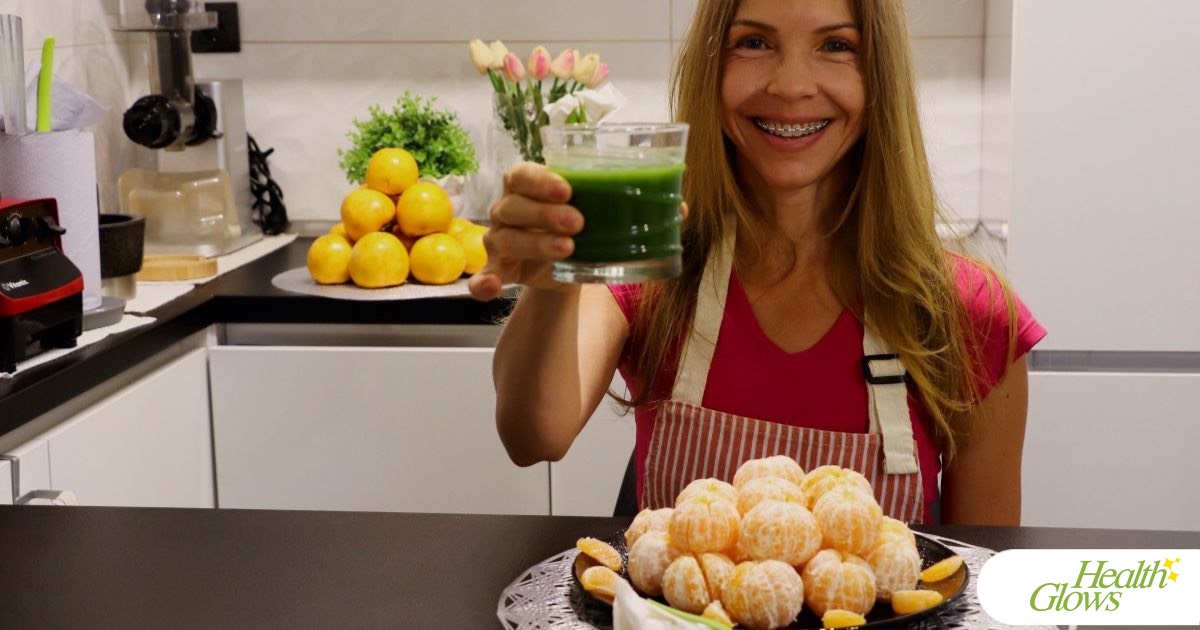
In the picture: Marina from Health Glows sitting at a table with a plate of tangerines and holding a glass of green juice
Which Fruits Should You Eat for Breakfast, Which for Lunch and Why?
This question refers to the fact that I suggest eating the juiciest fruit for breakfast and the sweetest fruit for lunch along with a cucumber or lettuce. In the raw vegan breakfast lesson, I explain why juicy fruit is the best food for breakfast, and in the raw vegan lunch lesson, I explain why sweet fruit is the best food for lunch.
- Is it okay to reverse the order, meaning to eat sweet fruit for breakfast and juicy fruit for lunch?
That’s fine of course if that is how it feels good to you. You will certainly already feel the benefits of having fruit for breakfast and lunch. But I would encourage you to understand the following:
- There is a reason why I suggest that the most water-rich food goes in the first meal of the day, then the food with a little less water in the second meal of the day, and finally the food with the least water goes for dinner. The reason is called: a one-way street with no room to detour. That’s right – your digestive system is a one-way street with no detours.
- The most water-rich food – passes through the fastest. And vice versa, food that has less water passes through more slowly. If you first put the food that passes more slowly in that one-way street, and then add food that passes faster, you will cause traffic jams and fermentation.
But again… if you like to eat sweet fruit for breakfast, for example bananas, and then for lunch to eat some juicier fruit, for example peaches – that’s fine as long as you feel good about that order of meals.
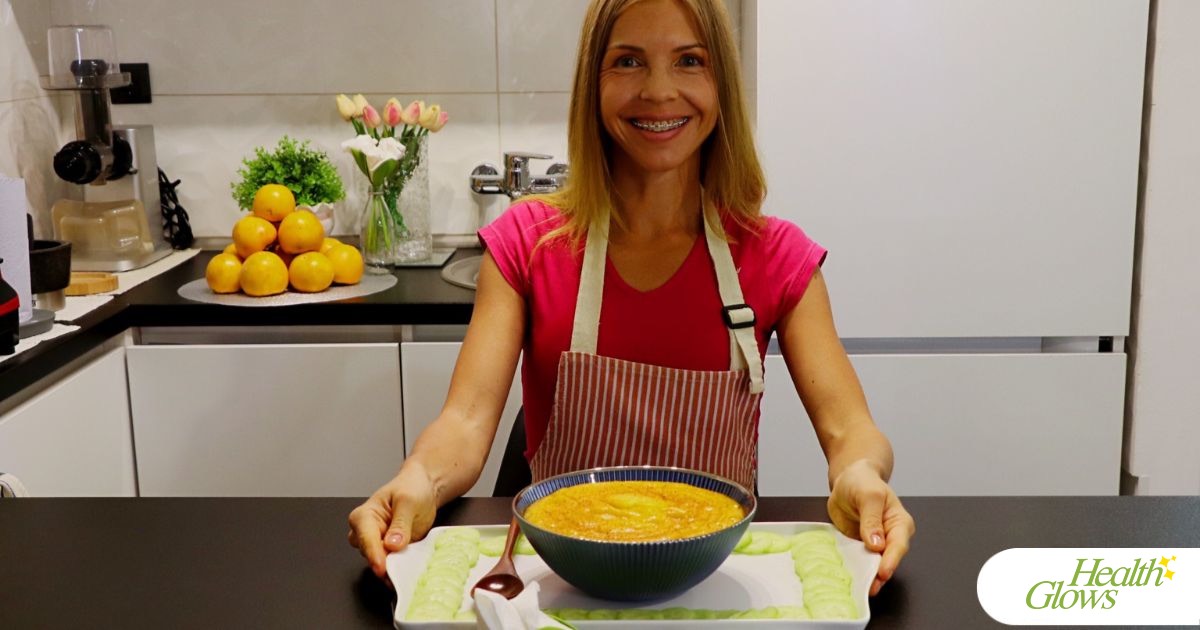
In the picture: Marina from Health Glows sitting at a table with a bowl of persimmon pudding and a tray with sliced cucumbers
Which Vegetables to Use for Making Green Juice?
The green juice that I suggest to be drunk in the morning along with a juicy fruit breakfast can be made from various citrus fruits and green leafy vegetables.
Here is my highly recommended green juice recipe:
- Granny Smith apples
- celery
- Swiss chard
- parsley
- dill
- baby spinach
Quantities are optional.
You can use all these foods in the juice, or just some from the list, according to your choice.
You can order a quality juicer in the Amazon Glows online shop.

In the picture: Two glass bottles and a glass full of green juice, standing in front of a juicer
Should You Eat Fruit for Dinner on a Raw Diet?
This question is about an example of a raw vegan dinner that I made and showed in the raw vegan dinner lesson. In this example of a raw vegan dinner, I made:
- Aperitif – pomegranate and orange juice
- Main course – raw vegan macaroni and cheese
- Salad – cucumber and microgreens in lemon juice
These three courses are all part of one dinner.
- Is it okay to eat whole citrus fruits as an introduction to dinner instead of having a juice?
Of course! I only make this citrus juice as an introduction to dinner during the pomegranate season. During the other months, I typically eat whole fruits as an introduction to dinner, examples are: pineapples, oranges, peaches, nectarines, grapes, berries. It is important that the fruit is not too sweet and that it is not watermelon or melon.
- Why is it good to have some not-too-sweet fruit before a vegetable dish?
It is good to eat fruit before a vegetable dish for dinner, because vegetables have very few calories, not enough to satiate the average person. If you try to eat only salad for dinner, you’ll either end up putting too much fat in your salad dressing, or you’ll crave some cooked starch.
This problem is easily solved by introducing not-too-sweet fruit as the first part of the dinner.
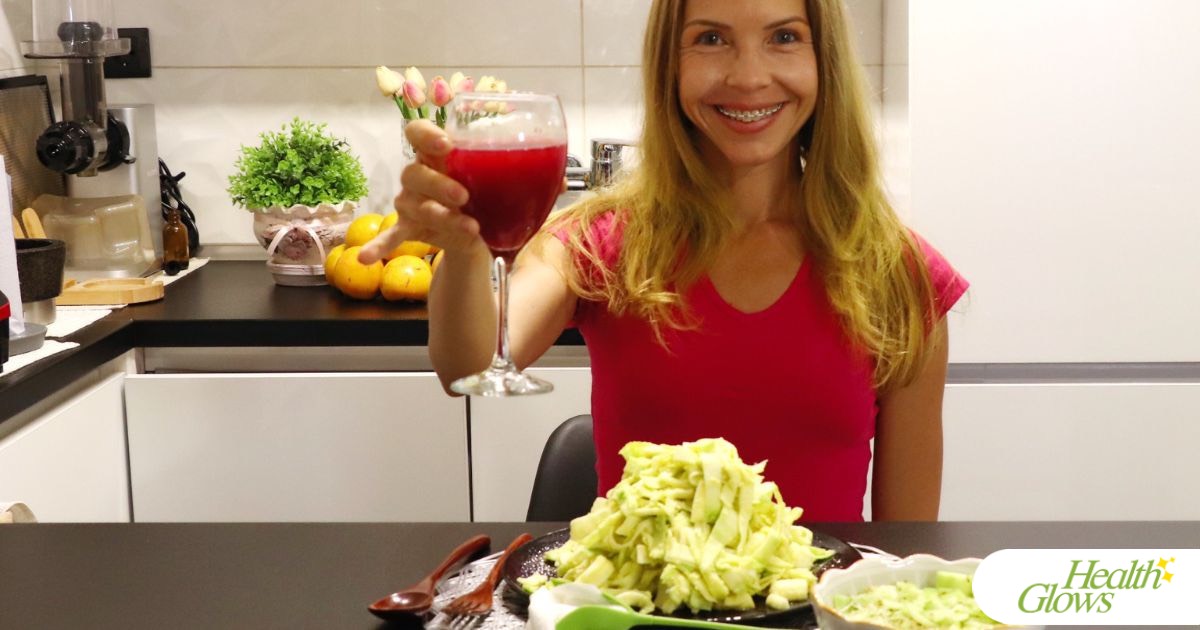
In the picture: Marina from Health Glows sitting at a table with a plate of raw vegan mac and cheese, and holding a glass full of pomegranate juice.
Why Smoothies Are NOT Optimal Food?
This question refers to the fact that in the examples of different meals, there is no a single smoothie anywhere. I’ve been mentioning this for 12 years now… making smoothies and drinking smoothies, especially drinking liquid food through a straw – this is not a healthy habit!
Blending food results in air being pulled into the food and oxidation of the food. When you drink liquid food, you most likely skip chewing. Chewing food is an extremely important first step in the digestion process. Also, the food is taken in too quickly. If the smoothie is drunk through a straw, it’s even worse, because drinking liquid food also pulls air through the straw straight into the stomach and intestines. The consequences are the accumulation of air molecules in the stomach, or even the intestines, which leads to flatulence.
Having said all this, I understand that there are medical conditions when people cannot chew and swallow. In these situations the only solution to feed a person is to give them liquid food on a spoon or straw.
If you like smoothies, you can still enjoy them, but I highly suggest making them as thick as possible, and adding chopped fruit to them so you have a reason to slow down with eating and chew. Instead of drinking food or drinking food on a straw, eat your smoothie with a spoon.

In the picture: A bowl full of mashed bananas, strawberries, and grated nutmeg
How Long Have I Been on a Raw Diet?
I switched to a vegetarian diet in 2004, to a vegan diet in 2005, and to a raw vegan diet in 2012.
Differences between these diets:
- Vegetarian diet – excludes the consumption of meat and all meat products
- Vegan diet – excludes the consumption of meat, meat products, milk, dairy products, eggs and honey – therefore, all products of animal origin
- Raw vegan diet – excludes the consumption of all cooked food
A raw vegan diet is a diet rich in fresh fruits and vegetables! A raw vegan diet includes the consumption of:
Citrus fruits – tangerines, oranges, pineapples, kiwi…
Sweet fruit – watermelons, melons, bananas, grapes, figs, persimmons, dates, mangoes, peaches, nectarines…
Fatty fruits – avocado, durian, coconut, acai
Vegetables – zucchini, cucumbers, tomatoes, celery, bell-peppers, lettuce, spinach…
Nuts and seeds (in very moderate amounts) – sunflower, sesame, flax, chia, walnuts, almonds, Brazil nuts

In the picture: Marina from Health Glows holding a plate of raw vegan mac and cheese and a wine glass full of pomegranate juice
For the Very End
I hope you find these answers to your most frequently asked questions helpful. If you have any more questions for me about a raw vegan diet, feel free to ask them in the comments below, I’ll be happy to answer!
Cheers,
Marina from Health Glows
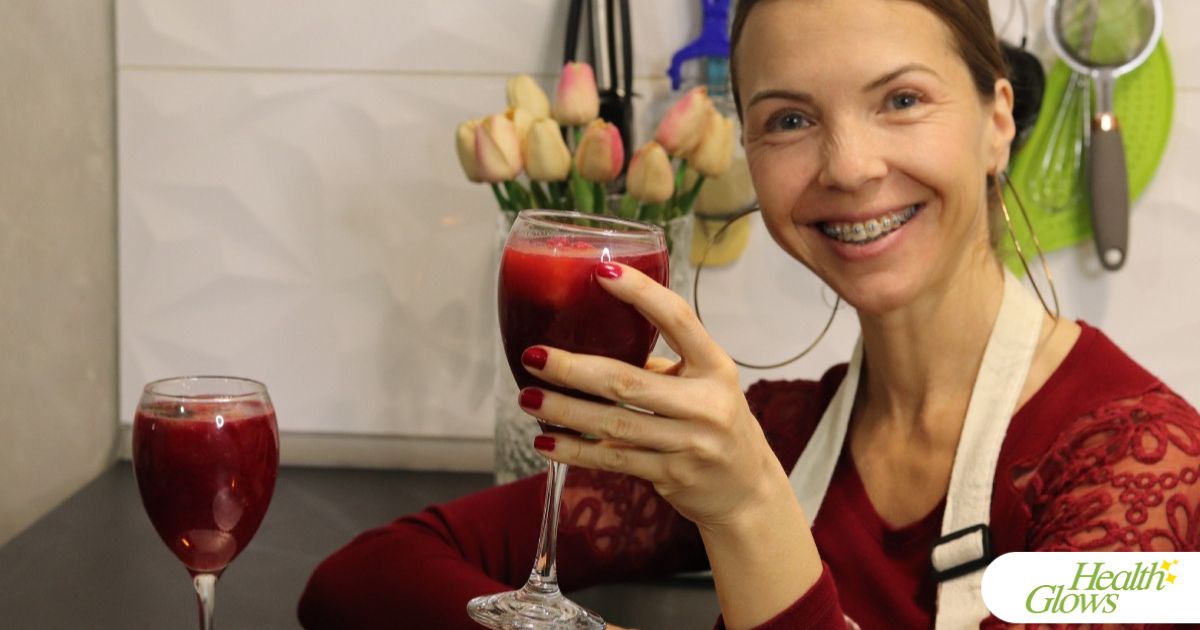
In the picture: Marina from Health Glows holding a wine glass full of pomegranate juice
Marina from Health Glows
As a certified raw vegan diet and healthy lifestyle coach, Marina helps her clients and followers to transition to a raw vegan diet in a proven and sustainable way in order to get rid of health problems and build a high level of health.